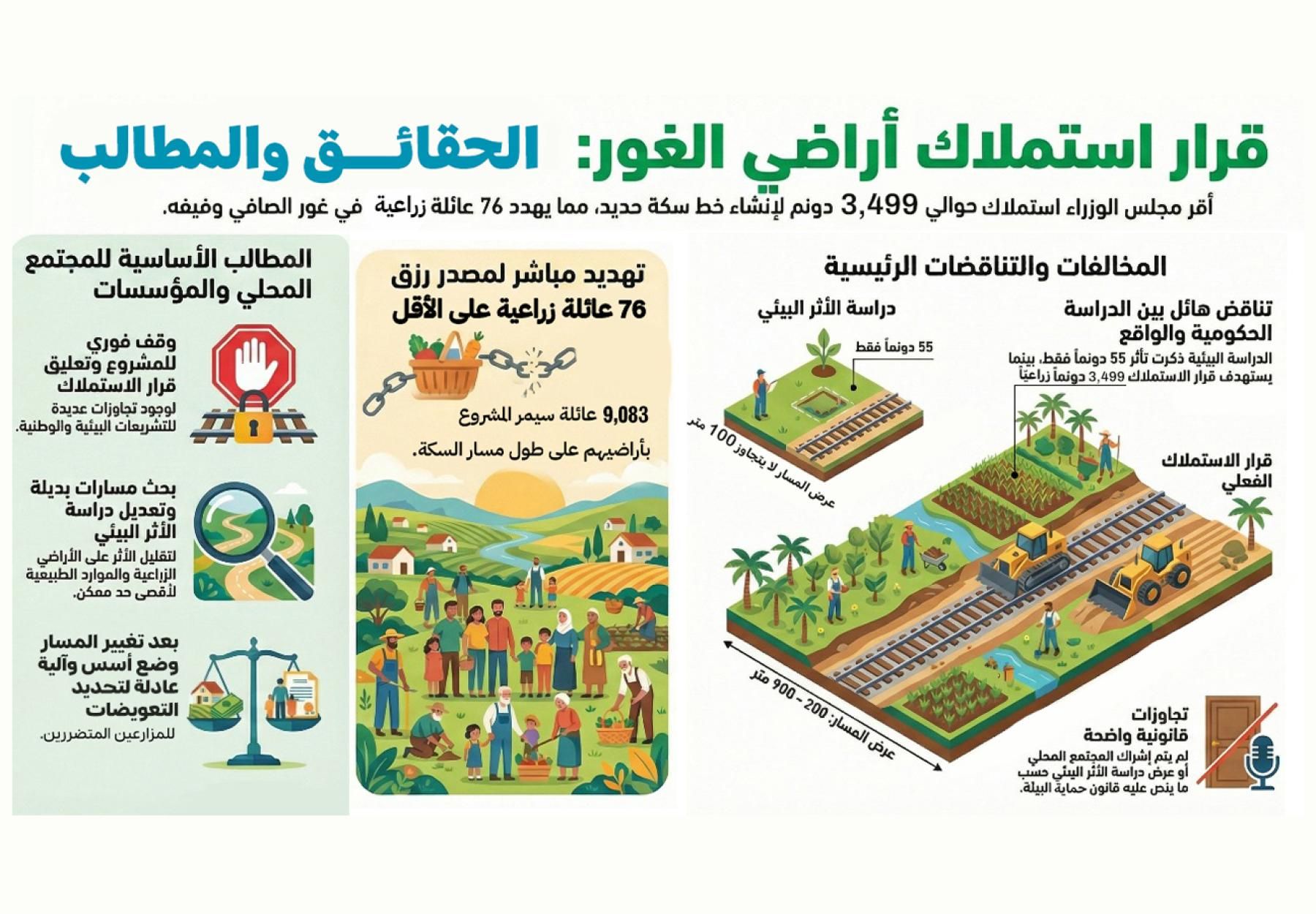
The issue of expropriating agricultural lands in Ghor es-Safi and Ghor Fifa in the Jordan Valley has seen significant developments in recent days, particularly following the government’s approval and its publication in the official gazette, despite the severe impacts on local communities and the limited agricultural lands. These developments have prompted parliamentary and rights-based actions, led by environmental actors including APN and members of the Parliamentary Agriculture and Water Committee, in coordination with farmers affected by the proposed railway line project for the benefit of the Arab Potash Company.
A position paper, drafted by environmental and legal organisations, was submitted to relevant government institutions and shared with members of the Parliamentary Agriculture and Water Committee. MP Basem Al-Rawabdeh submitted a parliamentary question to the government containing multiple points requesting detailed clarification about the project. The government’s responses provided information that became the starting point for organised follow-up by environmental organisations and parliamentary oversight, revealing discrepancies between the lands officially expropriated under the government decision, amounting to 2,179 dunums of private property and 1,320 dunums of public property, and the figures reported by the Ministry of Environment to the Parliament, which listed only 55 dunums.
Following these developments, APN organised a meeting that brought together MPs Basem Al-Rawabdeh and Fathi Al-Bawat, the National Center for Environmental Justice, and affected farmers, resulting in the agreement to form a representative committee of farmers to formally follow up on the issue with the relevant authorities.
The case traces back to a decision by the Land and Survey Department on 21 September 2025, which instructed the submission of a request to the Cabinet to expropriate approximately 3,499 dunums of land in Ghor es-Safi and Ghor Fifa for the Arab Potash Company, aimed at constructing a railway line connecting its factories in the Jordan Valley to the industrial port in Aqaba. According to official data, 62% of the targeted lands are owned by 76 families, while the remainder belongs to public institutional entities, a large portion of which is cultivated and leased to local farmers.
APN, along with 35 civil society organizations, expressed serious concerns about the expropriation decision and its potential impact on food sovereignty and national security, highlighting that the environmental assessment was not submitted to the competent committee for review, nor was there public discussion or meaningful local community participation. These gaps have raised legitimate concerns among farmers regarding their livelihoods, social stability, and food security in the region.