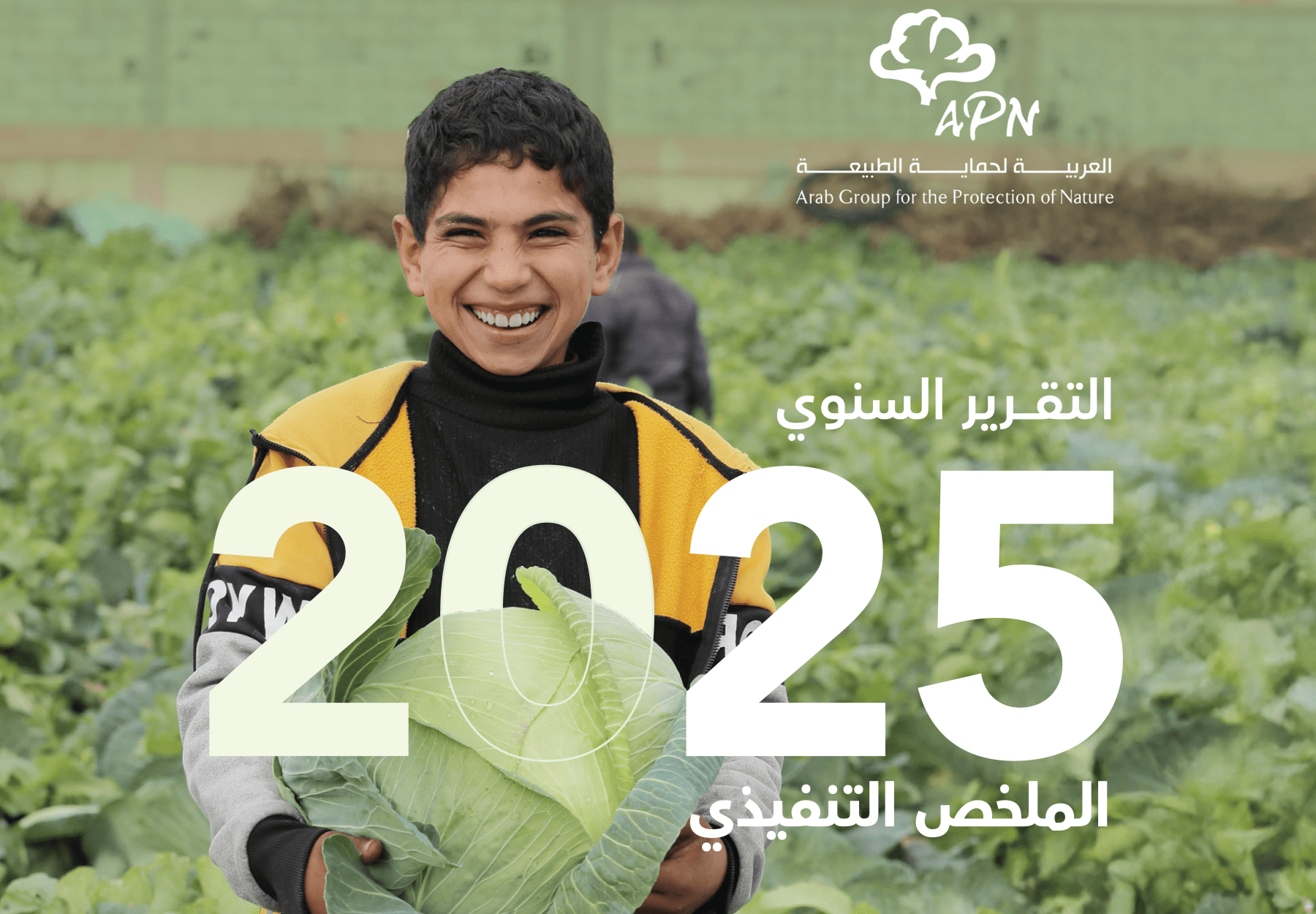
APN presented in its 2025 annual report the outcomes of a year rich in field achievements and international engagements, reaffirming its continued work across three main pillars: agricultural rehabilitation, advocacy, and mobilization. This approach has strengthened its position as one of the leading Arab organizations working to defend food sovereignty and protect land, despite the escalating political and humanitarian challenges in the region.
Under the agricultural rehabilitation pillar, APN continued implementing its agricultural programmes in Jordan, Palestine, and Lebanon. In Jordan, the Green Caravan programme saw the planting of 34,415 fruit trees for 807 farmers, alongside the conclusion of the “Economic Empowerment and Food and Water Security” Project in the Jordan Valley. This project included the distribution of trees and seeds, rehabilitation of water infrastructure, support for beekeepers, and the empowerment of women through productive initiatives, bringing the programme’s total since its launch to approximately 269,000 trees.
In Palestine, the Million Tree Campaign continued to strengthen farmers’ steadfastness through the planting of more than 140,000 fruit trees across various governorates, in addition to wheat cultivation, bringing the total planted since the programme’s launch in 2001 to over 3.1 million trees. The Revive Gaza’s Farmland Project also expanded in response to the destruction of the agricultural sector amidst the ongoing genocide, planting hundreds of thousands of vegetable seedlings, rehabilitating water infrastructure, and supporting fruit tree and wheat cultivation and beekeeping, alongside providing urgent food assistance at the height of the manmade famine. APN also launched the “Sumud for Advancing Food Sovereignty in Palestinian Villages” project, through developing agricultural and water infrastructure and enabling farming households to achieve self-sufficiency by utilizing home gardens and small-scale farms. In Lebanon, the “Together for Lebanon’s Olives” project began rehabilitating lands affected by Israeli attacks, planting 12,200 olive seedlings across 52 border villages and supporting wheat production in one of them.
In the policy advocacy pillar, APN intensified its presence in regional and international forums, defending the right to food and food sovereignty, and calling for accountability over the use of starvation as a weapon in Gaza. It also succeeded in integrating accountability-related provisions into negotiations of the UN Committee on World Food Security, and contributed to shaping regional positions on land, environment, and food justice, alongside leading national campaigns in Jordan to protect agricultural lands and producing studies and recommendations to strengthen food sovereignty.
In the mobilization and awareness pillar, APN launched the International People’s Tribunal on Forced Starvation and Ecocide in Palestine in Barcelona, in collaboration with international organizations, which concluded by condemning the occupation for crimes of genocide, ecocide, and forced starvation. It also led international solidarity initiatives for Palestine and Sudan, and participated in Arab and international conferences and intellectual platforms to advance the concept of “Green Resistance” and link food sovereignty with liberation struggles and environmental justice.
On the awareness front, the “If Only You Knew” programme continued to spread agricultural and food sovereignty awareness across schools, universities, and refugee camps, reaching thousands of students and volunteers. APN also strengthened its media presence through dozens of press materials and interviews covering its programmes and initiatives in Arabic, English, French, German, and Spanish, thereby expanding its outreach and reinforcing its regional and international presence.